

Best Fire Inspection Software (2026)
Compare top fire inspection software platforms using criteria that matter for compliance, field execution, AI workflows, and end-to-end operations.
By Poseidon Team
March 2, 2026
2026 Buyer's Guide
What to Look For in Fire Inspection Software
Not all inspection platforms are built for fire protection workflows. Many field service tools can schedule jobs, but they break down when you need code-specific forms, AHJ-ready reporting, and fast deficiency follow-up. If you are evaluating software, these are the capabilities that matter most.
- NFPA compliance out of the box, with easy customization: Your platform should include pre-built inspection workflows aligned to standards like NFPA 25, 72, 10, 13, and related jurisdictional requirements, while still letting your team quickly tailor checklists, fields, and report outputs to your service model.
- AI-enhanced workflows in 2026: Platforms should layer AI into inspections, work order creation, and billing workflows so data collected in the field automatically drives action.
- Deficiency-to-revenue workflow: Logging deficiencies is only step one. Strong platforms should turn deficiencies into proposals, work orders, and invoices in one connected flow without re-entering job data.
- AHJ-ready reporting: Inspection reports should be clear, complete, and ready to submit without manual formatting, spreadsheet cleanup, or third-party report builders.
- Built-in end-to-end operations, not patchwork integrations: In 2026, the full lifecycle from inspection to proposal, work order, billing, and financial visibility should run natively in one platform to reduce tool count and keep operations, service, and finance aligned without duplicate entry or constant system handoffs.
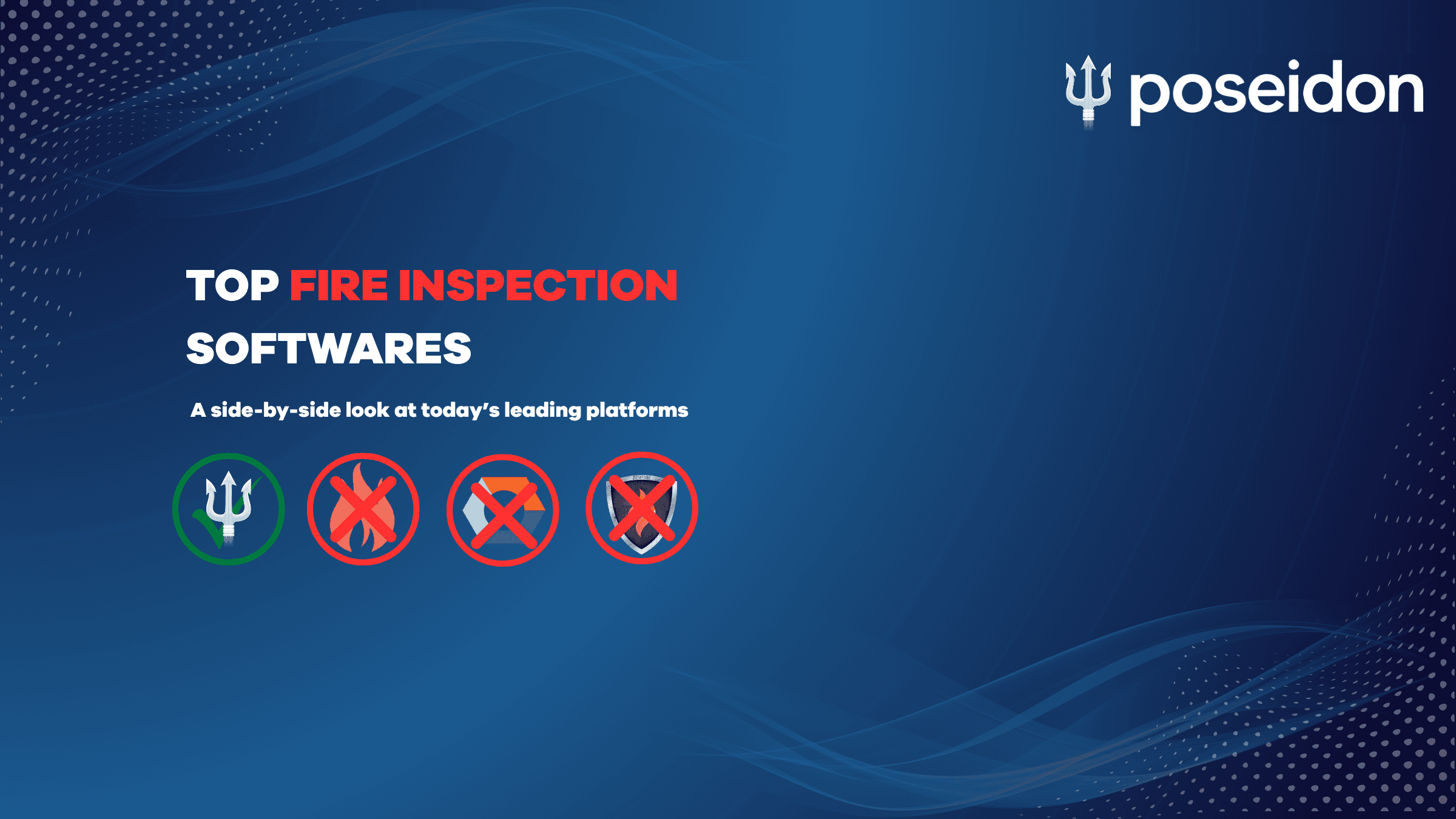
1. Poseidon
Poseidon is built to run the full inspection workflow from the field, not just digitize forms. Technicians can complete inspections in a mobile-first experience with offline support, capture deficiencies in real time, and move work forward without waiting to get back to the office. AI-driven inspection flows also help crews move faster by guiding documentation and reducing repetitive manual entry.
At the same time, office teams get live visibility into in-progress inspections, deficiency volume, and what needs action next. Dispatch can route the right technician to scheduled work and newly discovered deficiencies as they are encountered, while operations and billing stay aligned on one shared workflow.
Why Teams Choose Poseidon
- AI-driven inspections that feel conversational, guiding technicians through findings and next steps instead of forcing rigid form-only workflows.
- Offline-first field execution with automatic sync when service returns.
- Live office visibility into ongoing inspections, technician progress, and real-time deficiency status.
- Smart dispatching that routes the right technician by skill, location, and availability for both scheduled jobs and deficiency follow-up.
- Client quote approval directly in-app to reduce approval lag and speed close rates.
- Client invoice delivery through the platform for faster, cleaner billing handoffs.
- AHJ-ready reporting output that keeps documentation consistent and submission-ready.
- One connected operational record from inspection through dispatch, service execution, and billing.
2. Uptick
Uptick is a fire inspection platform purpose-built for fire protection businesses. It covers core operational workflows such as scheduling, inspections, quoting, and invoicing, with a strong focus on managing fire and life safety systems including alarms, extinguishers, and sprinkler equipment.
The platform is Australian-based and has expanded into the US market. It offers customizable templates and mobile tools for field teams, but many organizations will still need to build a meaningful amount of template structure themselves. Based on current product positioning, Uptick does not provide AI-powered inspection workflows or AHJ submission capabilities.
Commonly Listed Capabilities
- Fire-protection-focused platform covering inspections, scheduling, quoting, and invoicing.
- References support for local standards (including NFPA and AES) with dedicated mobile apps.
- Client portal, dashboards, and defect-quoting workflows.
- Accounting integration options with per-user monthly pricing.
Constraints to Validate
- Less ideal for installation-heavy business models.
- Template customization is available, but significant setup work may still be required.
- No AI-powered inspection tooling.
- No AHJ submission capability.
3. Ember Software
Ember Software is built for fire protection businesses and focuses on scheduling, inspections, quoting, and reporting in one operating platform. Based on Ember's public product pages, it emphasizes technician-friendly mobile workflows, digital forms, scheduling coordination, and faster proposal/invoice turnaround.
Ember highlights NFPA and state-specific forms, customer/job data centralization, and reporting workflows for office teams. For AHJ submission, Ember positions one-click submission through The Compliance Engine integration. Across publicly available product materials, AI-powered inspection workflows are not a core part of the feature set.
Commonly Listed Capabilities
- Fire-service-focused coverage for scheduling, inspections, quoting, and reporting.
- Customizable digital forms, including NFPA and state-specific templates.
- Mobile technician workflows with recurring scheduling and reporting support.
- Invoicing/accounting integration options plus client-facing status visibility tools.
Tradeoffs to Evaluate
- AHJ submission is handled through The Compliance Engine integration rather than a native built-in submission layer.
- Template customization is available, but teams may still need to build and maintain substantial template structure.
- Public product positioning does not currently emphasize AI-driven inspection capabilities.
- Pricing is generally handled through demo/contact-based sales conversations.
4. Buildertrend
Buildertrend is a broad construction management platform positioned for home builders, remodelers, and specialty contractors. It combines sales, project, financial, and communication workflows in one system, including scheduling, daily logs, change orders, invoicing, and client portal capabilities.
For fire inspection companies, Buildertrend can support general operational workflows, especially teams that want a strong client communication layer and mobile coordination tools. However, it is not marketed as a fire-protection-specific platform, so fire-focused organizations should validate code-driven form depth, AHJ workflows, and inspection-specific lifecycle fit before adopting it as a primary inspection system.
Commonly Listed Capabilities
- Broad construction platform covering project, financial, and communication workflows.
- Mobile app with offline access for core field tasks.
- Client portal for approvals, communication, invoicing, and payments.
- Custom-quote pricing model with unlimited-user positioning.
Fire Inspection-Specific Considerations
- Platform positioning is centered on home builders, remodelers, and general specialty contractors rather than dedicated fire inspection operations.
- No clear public emphasis on built-in NFPA-first inspection form libraries comparable to fire-focused platforms.
- No clear public emphasis on native AHJ submission workflows in fire-inspection contexts.
- AI messaging appears focused on client communication updates, not AI-guided inspection execution.
5. PlanGrid
PlanGrid is Autodesk's field productivity product focused on giving teams real-time access to plans, issues, photos, forms, and related project information. Today, Autodesk positions PlanGrid as part of the broader Autodesk Build and Autodesk Construction Cloud ecosystem, with mobile access through the PlanGrid Build / Autodesk Construction Cloud app.
For fire inspection teams, PlanGrid can support core field documentation and collaboration workflows, but its public positioning is construction-general (GCs, subcontractors, owners) rather than fire-protection-specific. Teams should evaluate whether fire-specific requirements like NFPA-first inspections, AHJ-ready submission workflows, and deficiency-to-revenue lifecycle depth are met natively or require additional products/configuration.
Commonly Listed Capabilities
- Sheet-centric field collaboration with plans, issues, photos, and forms.
- Mobile access on iOS and Android through Autodesk Construction Cloud tooling.
- Office/field coordination workflows tied to Autodesk Build/ACC.
- Useful for teams already standardized on Autodesk's ecosystem.
Fire Inspection-Specific Considerations
- PlanGrid is no longer sold to net-new customers as a standalone purchase; access is through Autodesk Build.
- Public product positioning is broad construction management, not specifically fire inspection operations.
- Fire-focused capabilities such as deep NFPA-centric workflow libraries are not prominently positioned on PlanGrid product pages.
- AHJ submission and full deficiency-to-billing lifecycle capabilities should be validated at the Autodesk Build/ACC solution level.
6. Procore
Procore is a large construction management platform used by owners, general contractors, and specialty contractors. It positions itself as an end-to-end system spanning preconstruction, project management, quality/safety, financials, and closeout workflows.
For fire inspection organizations, Procore can be a strong option when broader construction portfolio control is the priority. It offers a deep product ecosystem, but fire inspection teams should validate how much configuration or integration is required to match fire-specific compliance and service workflows.
Commonly Listed Capabilities
- Large construction suite spanning project, financial, and risk workflows.
- Extensive integration marketplace and mobile coverage across major modules.
- AI feature positioning exists in broader construction workflows.
- Custom annual pricing with unlimited-user/data positioning.
Fire Inspection-Specific Considerations
- Platform depth is broad construction-first, not fire-inspection-first.
- Fire-specific NFPA-centric inspection templates and workflows may require heavier setup.
- AHJ submission and deficiency-to-revenue specialization should be validated per implementation scope.
- Custom quote pricing and enterprise rollout scope can be heavier for smaller service teams.
7. Fieldwire
Fieldwire (a Hilti company) is focused on field coordination, plan management, task execution, and jobsite communication. It is widely used to align office and field teams on active work through mobile tasking and plan-based collaboration.
For fire inspection teams, Fieldwire can be useful for execution visibility and field accountability. However, it is typically strongest as a field coordination layer, so teams should confirm whether full fire inspection-to-billing lifecycle depth is covered natively.
Commonly Listed Capabilities
- Plan-and-task-oriented field coordination workflows.
- Mobile collaboration for field and office teams.
- Checklist/punch-list style tracking for execution and quality.
- Publicly listed per-user pricing tiers.
Fire Inspection-Specific Considerations
- Core positioning is field coordination rather than fire-specific compliance operations.
- NFPA-first forms, code libraries, and AHJ-focused workflows should be validated directly.
- Deficiency quoting, client approval, and inspection-to-invoice lifecycle depth may require additional systems.
- Teams seeking all-in-one fire service operations should test fit beyond task management.
8. Sage 300
Sage 300 Construction and Real Estate is a construction-focused ERP platform with strong accounting, project controls, and financial management capabilities. It is typically used by teams prioritizing back-office rigor, job cost visibility, and enterprise financial governance.
For fire inspection companies, Sage 300 can provide robust financial backbone and operational controls. The main evaluation point is whether field inspection workflows, mobile technician experience, and fire-specific compliance execution are handled natively or through added products and process layers.
Commonly Listed Capabilities
- Construction ERP/accounting depth for back-office and financial control.
- Job costing and financial reporting for larger operations.
- Designed for organizations needing tighter governance and controls.
- Sales-led subscription model for tailored deployment.
Fire Inspection-Specific Considerations
- Primary strength is ERP/back-office depth, not technician-first inspection execution.
- Mobile field inspection and fire-compliance workflows may require complementary systems.
- Fire-specific NFPA and AHJ process depth should be validated implementation by implementation.
- Adoption effort and configuration complexity can be higher than lightweight field-focused tools.
9. Inspect Point
Inspect Point is a fire and life safety platform focused on inspection, service, compliance, and revenue workflows. It is positioned as a purpose-built solution for fire protection teams and emphasizes end-to-end workflows from scheduling through invoicing and collections.
Based on public product pages, Inspect Point highlights embedded AI assistance, code-compliant inspection workflows, extensive form libraries, and integrations for compliance and business systems. It is generally positioned for teams that want fire-specific operational depth rather than a generic field service stack.
Commonly Listed Capabilities
- Fire/life-safety-focused inspection and service positioning.
- AI and fire-code/form-library coverage called out in product messaging.
- Mobile/offline field workflows with integrated service and billing lifecycle tools.
- Integrations for compliance/business systems plus client-facing visibility features.
Evaluation Considerations
- Confirm implementation scope and timeline for your specific process, especially if migrating from legacy systems.
- Validate which integrations are native versus connector-based in your stack.
- Confirm pricing model and scaling costs by user count, modules, and data volume.
- Test mobile workflow fit for your exact trade mix (alarm, sprinkler, extinguisher, special hazards, etc.).
10. ZenFire
ZenFire is positioned as fire inspection software for compliance-driven teams, with messaging centered on AI-assisted inspections, built-in NFPA forms/checklists, recurring inspection workflows, and inspection-to-invoice operations.
Public product pages also emphasize usability for smaller teams and solo inspectors, per-user pricing simplicity, and coverage across scheduling, dispatch, reporting, invoicing, and payments. It is presented as a purpose-built fire workflow rather than a generic contractor tool.
Commonly Listed Capabilities
- Fire inspection positioning with recurring inspection/compliance workflows.
- AI-assisted inspection messaging and built-in NFPA form/checklist coverage.
- Inspection/reporting/invoicing flow with field-service operations tooling.
- Per-user pricing and integration-support messaging.
Evaluation Considerations
- Validate depth of code-library coverage for your exact jurisdiction and trade requirements.
- Confirm AHJ submission and compliance-delivery workflow capabilities in production use cases.
- Verify enterprise-scale reporting, permissions, and analytics fit if you manage large multi-branch operations.
- Confirm implementation approach, training effort, and migration path from current tools.
Bottom Line
If your business runs fire and life safety inspections, the most important filter is whether the platform is actually built for fire protection operations. General-purpose contractor tools often mean extra setup, missing compliance depth, and disconnected workflows across field, office, and billing.
Poseidon is built to run the full lifecycle in one platform, from compliant inspections and AI-assisted workflows to dispatch, deficiency follow-up, reporting, and invoicing. If you want fewer tools, faster execution, and stronger operational visibility, Poseidon should be at the top of your shortlist.
Ready to Simplify Field Operations?
Book a live demo to see how your team can manage inspections, dispatch, reporting, and job tracking in one place.